DACHSER deliveries are emission-free in 25 European cities
60 electric vehicles and 13 cargo bikes in use – DACHSER Emission-Free Delivery implemented in ten countries
At the beginning of 2023, DACHSER announced its plan to double the number of its urban zero-emission delivery areas in Europe over a three-year period. The logistics provider realized this goal by the end of 2025. In 25 major European cities and metropolitan regions in ten countries, DACHSER has specified downtown areas in which it delivers non-refrigerated groupage shipments with zero local emissions. The company has thus implemented a further component of its long-term climate strategy.
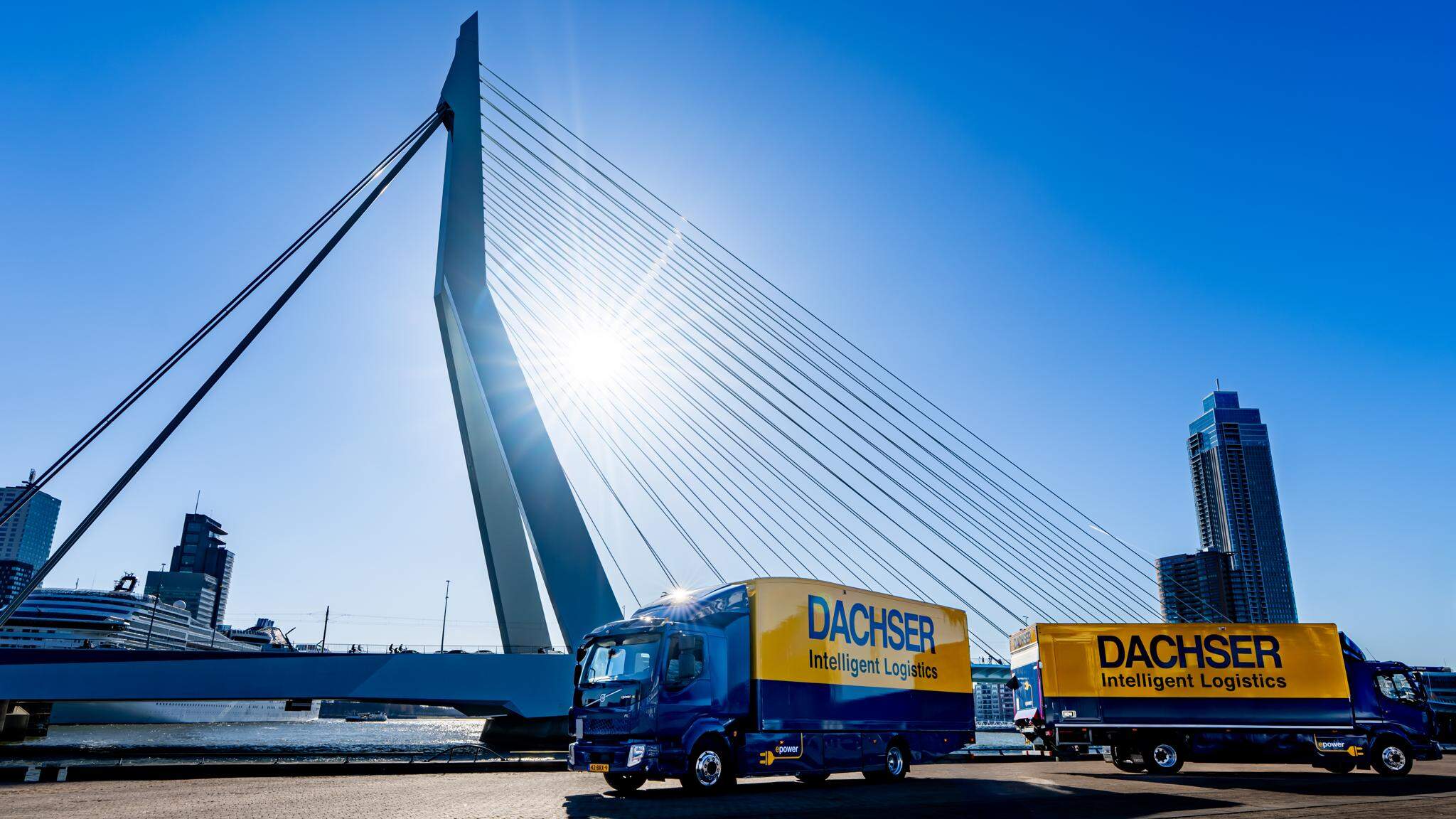
A combination of battery-electric trucks, electrically assisted cargo bikes, and microhubs near city centers allows DACHSER to make deliveries with zero local emissions. The company currently operates 60 electric vehicles and 13 cargo bikes in the 25 cities. In 2025, those vehicles covered around 1.8 million kilometers without emitting greenhouse gases—that’s an average of around 7,000 kilometers per day. This meant the company saved some 1,000 metric tons of CO2e in 2025. The savings potential of electric vehicles depends on the electricity mix that powers them. Using green electricity, the savings in this case amount to 1,544.75 metric tons of CO2e (well-to-wheel). Calculated using Germany’s domestic electricity mix, the figure is 986.06 metric tons of CO2e.
DACHSER Emission-Free Delivery was developed at the Kornwestheim branch and debuted in the city of Stuttgart in 2018. That same year, the pilot implementation received an award from Germany’s Federal Ministry for the Environment in the national Sustainable Urban Logistics competition. “DACHSER Emission-Free Delivery was when we started to systematically integrate climate action into our day-to-day logistics operations instead of just talking about it,” says Stefan Hohm, Chief Development Officer (CDO) at DACHSER. “We’re pursuing measures that work under realistic conditions and that help decarbonize logistics.”
We’re pursuing measures that work under realistic conditions and that help decarbonize logistics.
Stefan Hohm, CDO at DACHSERBy the beginning of 2023, when DACHSER launched “Mission Doubling,” it had already established twelve DACHSER Emission-Free Delivery areas. The basis for the expansion to ultimately 25 cities—one more than originally planned—was a modular principle that the individual branches apply based on local conditions. Numerous employee suggestions solicited through a global ideas campaign on climate action were incorporated into the development of the modular toolbox.
With its zero-emission city delivery concept, DACHSER plays a valuable role in improving air quality in heavily polluted urban areas, as e-trucks and cargo bikes don’t emit any greenhouse gases locally. What’s more, the drivers enjoy better working conditions, since battery-electric vehicles don’t cause engine vibrations and are generally quieter and more pleasant to drive. The response from customers, local authorities, and residents has been positive as well.
In addition, DACHSER Emission-Free Delivery has laid a solid foundation for responding to the expected increase in bans on conventional vehicles in European cities. DACHSER comprehensively monitors what vehicles are used within the defined emission-free delivery zones and documents all unplanned deviations (of which there are very few overall). The reliability rate achieved for emission-free deliveries across all cities in 2025 was 95%.
Collaboration in the European network
Implementation in the 25 cities—Amsterdam, Barcelona, Berlin, Cologne, Copenhagen, Dortmund, Dublin, Düsseldorf, Freiburg, Hamburg, London, Madrid, Malaga, Munich, Oslo, Paris, Porto, Prague, Rotterdam, Stockholm, Strasbourg, Stuttgart, Toulouse, Vienna, and Warsaw—took the conditions of each location into consideration.
The size of the delivery zone varies from city to city. As a rule, it covers busy downtown locations such as shopping areas or old historic city centers. In Freiburg, the emission-free delivery zone has been successively expanded and now covers the entire city. The choice of vehicles also differs depending on the local situation.
“A key factor in bringing the concept to new cities was the increasing availability of suitable production-ready vehicles, especially battery-electric trucks with sufficient payload and reliable service and maintenance offers,” explains Alexander Tonn, COO Road Logistics at DACHSER. “When we started this project, our options were much more limited.”
Over time, a project community emerged among all participating branches, in which they shared their experiences and developed local solutions further. “The integration of DACHSER Emission-Free Delivery into our existing network processes was a key step in transferring the concept into daily operations,” Tonn adds. “Thanks to the modular toolbox and close support from experts in the Head Office and the project community, our branches can select the elements that work for their location. This enables them to put emission-free delivery into practice and incorporate it into existing processes.”

A key factor in bringing the concept to new cities was the increasing availability of suitable production-ready vehicles.
Alexander Tonn, COO Road Logistics at DACHSERThis milestone notwithstanding, the expansion of emission-free city-center delivery and the transformation toward net zero emissions remain long-term and continuous tasks for the family-owned company. As DACHSER CDO Hohm says, “For us, decarbonization is part of our corporate responsibility—technology neutral, based on facts, and with a focus on process and energy efficiency. We see ourselves as an impulse generator for logistics in the area of sustainability; we reject symbolic announcements that can’t be reliably implemented.” Sustainable logistics must also make economic sense and be planned along realistic execution profiles, flanked by reliable framework conditions, and understood and implemented as a learning curve within the company. “We’re staying on course with decarbonization with the clear goal of reducing emissions step by step and securing our competitiveness,” Hohm says.